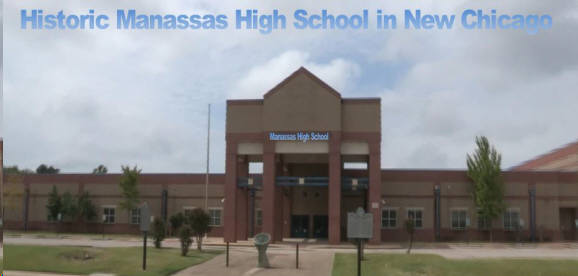
Manassas High School stands as a sacred monument in North Memphis—a beacon of Black excellence, resilience, and cultural genius. Founded in 1899, it became the first four-year accredited public high school for African Americans in Shelby County.
The unknown and untold story Manassas High school is the story of Memphis White Supremancy, Racism and Black on Black Racism. The new Manassas high school is located at 1111 North Manassas Street in Memphis, Tennessee 38107.
What is untold about Manassas High School is that if you travel North to the end of the street on the West side of Manassas Street is the location where the Manassas School was first built in then Shelby County in 1899. Instead of the City of Memphis and the County of Shelby installing a "Historica Marker" there is barbed wire and a disregard and a disrespect for Black Culture and history. 126 years ago the Shelby County Government built Manassas High School "The 1st High School for Blacks in Shelby. In 2025 the Black majority Shelby County Commissioners are voting and debating at putting an over one Billion dollar Jail Complex where there was "Education today in 2025 its Black Incarceration."
At this location the Manassas High School was built in 1899 later came and gone is Firestone Tire and Rubber today its "Rubber To Racism" where there is a school sign they want to put a Jail and a Jail sign for Blacks. Once it was education today they want this area for incarceration.
Manassas high school produced generations of scholars, artists, and leaders. Among its most legendary and unknown and untold figures was Jimmie Lunceford, a visionary educator who transformed Manassas into the birthplace of Memphis music education.
Originally hired as an athletic director, Lunceford became the school’s first band director, forming the city’s first high school orchestra and launching a musical legacy that would ripple across America. His students—many from the New Chicago neighborhood—were not just taught music; they were taught dignity, discipline, and pride. Lunceford went on to lead one of the most celebrated swing bands of the 1930's.
We are talking about being the best. We know about Count Basie, Duke Ellenington, Benny Goodman and others, however what is untold is about the students from Manasas high school became the best whereas they had a regular gig at "Cotton Club of Harlem" where you could not just be good, you had to be "Great"
Jimmy Lunceford never forgot Manassas. He returned often, performing for students and mentoring the next generation of Black musicians. This story of Manasas High School remain untold
Today, while this Manassas story goes unknow and untold that legacy is kept alive by Ron Herd II, a Memphis-born visual artist and activist who founded the annual "Jimmie Lunceford Jamboree Festival."
Ron Herd’s work is more than tribute—it’s resurrection. Each year, he brings music, memory, and movement back to Manassas High School, reminding Memphis and the world that this school is not just a building—it’s a cultural temple. Herd’s efforts have reclaimed Lunceford’s rightful place in history, challenging the city’s neglect and erasure of Black genius. His festival is a living archive, a grassroots act of defiance against institutional amnesia.
Click Here to learn more about Ron Herd and his work in Memphis.
But while Herd honors the past, others desecrate it. In a stunning act of racial disregard, Memphis leaders—spearheaded by former city councilman Kemp Conrad—have proposed building a $1.26 billion jail complex in the heart of New Chicago, directly touching Manassas Street.
If one travels north from Manassas High School on Manassas Street, they reach Firestone Avenue, where the southeast corner now threatens to become the footprint of incarceration. This is not development—it is defilement. The proposed Shelby County Justice Center would house thousands of inmates, including violent offenders, just steps from a historic Black high school and an elementary school. It is a grotesque inversion of justice: placing cages where there should be classrooms, punishment where there should be promise.
This is the story of “Rubber to Racism.” The Firestone Tire and Rubber plant once stood as an economic engine in North Memphis, employing Black workers and anchoring the community. Its closure in the 1980s gutted the neighborhood, leaving behind environmental damage and economic despair. Now, instead of restoration, the city offers incarceration.
The same land that once held opportunity is being repurposed for oppression. Kemp Conrad would never propose a jail in a white neighborhood like East Memphis or Germantown—certainly not one that touches the street of a historic school.
But in New Chicago, where Black children walk to Manassas High, the city sees no sacred ground. It sees only space for a cage.
This is not just poor planning—it is a racist act. It is a deliberate assault on memory, dignity, and community. It sends a message that Black history can be buried beneath concrete and razor wire.
In 1962 Grammy and Ocar winnier Issac Hayes graduated from Manassas High School. A historic Issac Hayes marker sits in front of the school whereas Manassas High Schoool is Historic. The Community that once made rubber is planned by others to the the "Hallmark of Racism" via a proposed jail Complext to be built in the community.
But the people of New Chicago are not silent they are pushing back. Leaders like Dr. Carnita Atwater, Ronald Anderson, Norman Redwing and Attorney Linda Nettles Harris who has joined this fight and others have risen in protest, declaring that no jail will desecrate their haven. Their voices echo the spirit of Lunceford, of Herd, of every student who ever walked the halls of Manassas High with dreams in their hearts.
Manassas High School is not just a landmark—it is a line in the sand. To build a jail on Manassas Street is to spit on the legacy of Black Memphis. It is to say that our children belong behind bars, not behind bandstands. But we reject that lie. We stand with Ron Herd, with Jimmie Lunceford, with every ancestor who built New Chicago from the ground up. We demand investment, not incarceration. We demand respect, not erasure. And we will not allow the story of Manassas High School to be rewritten by bulldozers and barbed wire.